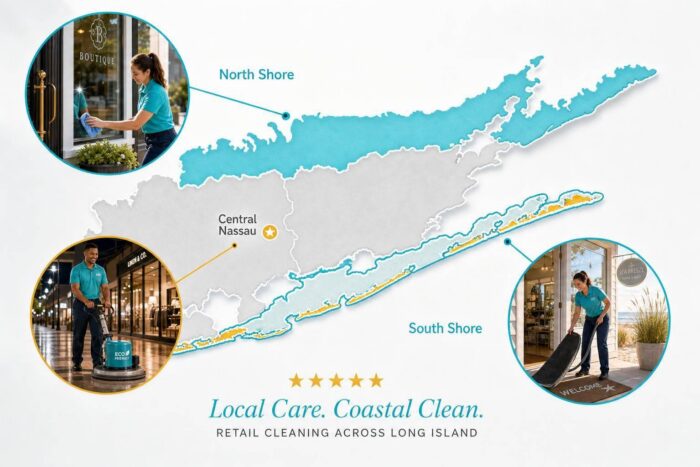
If you run a retail store on Long Island, your cleaning plan should match your location, traffic, and store type. In this guide, I break it down in simple terms: North Shore stores lean more on looks and detail work, Central Nassau handles heavier volume and overnight service, and South Shore stores deal with more dirt, salt, sand, and restroom use.
Here’s the short version:
- North Shore stores like Great Neck and Port Washington often need careful dusting, streak-free glass, and polished floors.
- Central Nassau areas like Garden City, Hempstead, and Hicksville often need nightly service, floor care, restroom cleaning, and trash pickup because traffic is heavier.
- South Shore stores like Freeport, Valley Stream, Rockville Centre, and Massapequa often need more entry cleaning, especially in winter.
- Bayside, Flushing, and Huntington can fit into Nassau-based routes, but service timing and scope depend on store density and distance.
- Most small and mid-size stores book 2–3 visits per week or nightly service.
- Deep cleans make sense for turnovers, renovations, seasonal resets, and new openings.
A few facts stand out:
- The first 15 feet inside a store entrance usually collect the most tracked-in dirt.
- Many busy stores add visits in Q4, back-to-school season, and winter.
- VCT floors in heavier-traffic stores may need strip-and-wax service every 4 to 6 months.
Quick comparison
| Area | Main issue | Common service window | Usual focus |
|---|---|---|---|
| North Shore | Store appearance | Before open / after close | Glass, fixtures, floor finish |
| Central Nassau | Heavy shopper volume | Overnight / mixed shifts | Floors, restrooms, trash |
| South Shore | Tracked-in dirt and moisture | After close | Entry mats, mopping, sanitizing |
| Bayside / Flushing | Dense storefront turnover | Overnight | Touchpoints, windows, trash |
| Huntington | Boutiques and plazas | Before open / overnight | Showroom cleanup, fitting rooms |
If you want to set the right schedule, crew size, or project scope, this guide gives you a simple map of how retail cleaning works across Long Island.
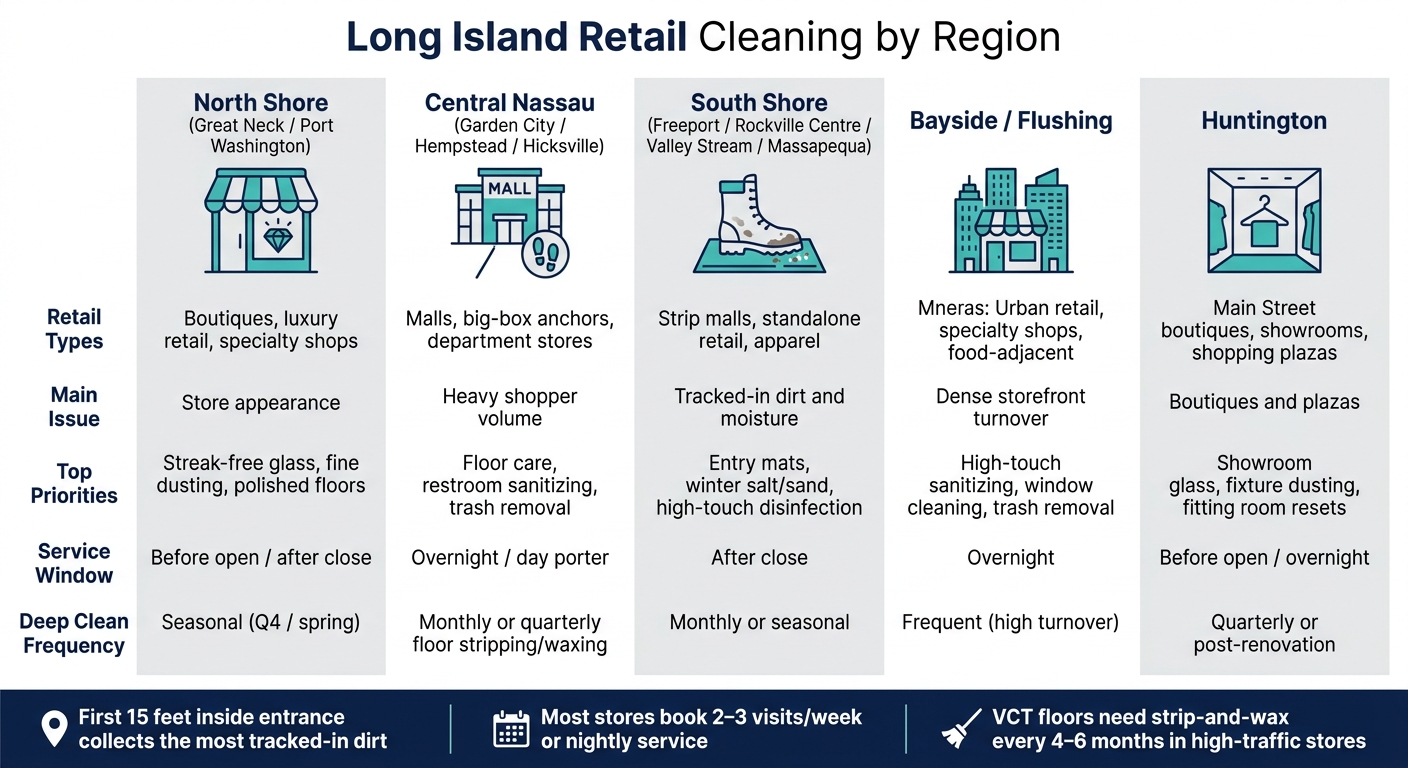
Long Island Retail Cleaning by Region: Quick Reference Guide
Retail Cleaning Coverage by Long Island Region
Crews usually move along major retail corridors plus the Long Island Expressway, Northern State Parkway, and Southern State Parkway to keep multi-stop service efficient.
Nassau County Corridors: North Shore, Central, and South Shore
For small and mid-size retailers, the main difference by area often comes down to this: is the job driven more by store appearance or by foot traffic?
On the North Shore, towns like Great Neck and Port Washington have a lot of boutiques, specialty shops, and luxury retail. These stores often book cleaning before opening or after closing. The focus is usually on detail-heavy work like glass polishing, careful fixture dusting, and floor care.
Central Nassau – Garden City, Hempstead, and Hicksville – handles much of the region’s heaviest retail volume. The Roosevelt Field area sits at the center of this corridor, with mall-scale sites and big-box anchors. Overnight service windows are common here. Some 24/7 businesses, like pharmacies, may also need zone-by-zone overnight cleaning.
On the South Shore, including Freeport, Rockville Centre, Valley Stream, and Massapequa, the retail mix is mostly strip malls and standalone stores. In these locations, entry-zone upkeep tends to be the main repeat issue, especially during winter when road salt, sand, and tracked-in debris pile up fast.
Nearby Service Reach: Bayside, Flushing, and Suffolk Retail Hubs
Beyond Nassau, coverage usually follows the same route-density logic into nearby retail hubs.
Some Nassau-based providers also serve Bayside and Flushing in western Queens, where route density makes add-on stops efficient. The retail mix there leans toward dense urban storefronts, specialty shops, and food-adjacent retail. That matters most for high-turnover storefronts and specialty shops that need overnight windows and high-touch disinfection.
Farther east, Huntington in Suffolk County sits near the outer edge of Nassau-based route coverage. Main Street boutiques, shopping plazas, and showrooms there usually schedule before-opening cleans. Some also ask for quarterly deep cleans or post-renovation prep.
Region Comparison Table
The table below condenses the main regional differences.
| Region | Typical Retail Formats | Common Cleaning Needs | Usual Service Windows | Deep-Clean Frequency |
|---|---|---|---|---|
| Great Neck / Port Washington | Boutiques, luxury retail, specialty shops | Detail dusting, glass polishing, showroom care | Before-opening or after-close | Seasonal (Q4 / spring) |
| Garden City / Hempstead / Hicksville | Malls, big-box anchors, department stores | High-traffic floor care, restroom sanitizing, trash removal | Overnight / before-open + day porter | Monthly or quarterly floor stripping/waxing |
| Freeport / Rockville Centre / Valley Stream / Massapequa | Strip malls, standalone retail, apparel | Entry mat maintenance, winter road salt, sand, and tracked-in debris, high-touch disinfection | After-close | Monthly or seasonal |
| Bayside / Flushing | Urban retail, specialty shops, food-adjacent retail | High-touch sanitizing, window cleaning, trash removal | Overnight | Frequent (high turnover) |
| Huntington | Main Street boutiques, shopping plazas, showrooms | Showroom glass, fixture dusting, fitting room resets | Before-opening or overnight | Quarterly or post-renovation |
sbb-itb-a8bcf38
North Shore vs South Shore Cleaning Patterns
North Shore retail cleaning is mostly about presentation. South Shore retail cleaning leans more toward traffic control and sanitation.
North Shore Stores: Detail Work, Glass, and Presentation
North Shore boutiques and specialty shops, including jewelry stores, luxury retail, and high-end apparel, live and die by how the space looks. Cleaning crews need to work around merchandise without moving displays[1][2].
Glass care takes up a big share of the work. Display cases and storefront glass need streak-free cleaning[1]. Floors may need monthly burnishing to keep that polished look. In busier stores, strip-and-wax service may be needed every 4 to 6 months[1][5]. Fitting rooms also need a nightly reset, with mirror wipes, floor washing, and hanger resets[1].
Most North Shore crews work before opening or after closing so shoppers aren’t interrupted and displays stay untouched.
South Shore Stores: High-Traffic Floors, Entrances, and Restrooms
South Shore retail spaces usually deal with heavier foot traffic. That includes shopping plazas, supermarkets, and standalone stores. So the focus shifts to entry zones, hard floors, restrooms, and trash removal[1][2].
The first 15 feet inside the entrance picks up most of the tracked-in soil. That’s why entry mats and frequent mopping matter so much[1]. Coastal stores also deal with sand and moisture at the door, plus winter road salt and slush[1][2].
In busier locations, day porter coverage often handles restroom restocking, spill response, and fitting-room resets[1][5]. VCT floors usually need stripping and waxing every 4 to 6 months[1].
These differences start to shape how stores book service, from timing to staffing.
North Shore vs South Shore Comparison Table
The split between these two areas affects the cleaning schedule, crew size, and overall scope.
| Feature | North Shore Retail | South Shore Retail |
|---|---|---|
| Dominant Retail Types | Boutiques, luxury goods, specialty shops, jewelry | Shopping plazas, supermarkets, standalone anchors |
| Peak Traffic Periods | Mid-day and weekday afternoons | Heavy weekends and evening shopping |
| Top Cleaning Priorities | Streak-free display glass, fine dusting, polished floors | Entry mats, restroom turnover, high-traffic floor maintenance |
| Ideal Service Timing | Before open or after close | Nightly plus day porter coverage for high-traffic locations |
| Seasonal Pressure Points | Holiday window displays and inventory resets | Summer sand and moisture, winter salt and slush |
Booking Patterns for Small and Mid-Size Retailers
Regional market differences also shape how often retailers book cleaning and what they pay. In Nassau County and nearby retail areas, the schedule usually comes down to three things: foot traffic, store layout, and when crews can get inside.
Typical Cleaning Schedules by Store Type
Most busy storefronts book cleaning nightly. Shops with lighter traffic often go with two or three visits per week. It’s pretty simple: more shoppers, more glass, and more restrooms usually lead to more frequent service.
High-traffic stores may also book scheduled floor restoration during peak seasons. Many retailers add extra visits during Q4 and back-to-school periods, and winter brings another issue into the mix. Salt and snow tracked in from outside can bump cleaning needs up fast [1][3].
What Affects Price, Crew Size, and Timing
Busy shopping centers often add daytime coverage for restocking messes, spills, and restroom checks [1]. Square footage usually sets the starting point for a quote, but it doesn’t tell the whole story. Floor type, restroom count, fitting rooms, and how sensitive the merchandise is all shape the final scope [1][3].
Access windows matter too. Some crews work before opening, some after closing, and some overnight. Stores that run 24/7, like pharmacies, often need overnight cleaning by area so parts of the location can stay in use while work gets done [1][4]. In practice, labor needs, access hours, floor type, restroom count, and fitting-room volume are what move both price and crew size.
The table below shows how those factors usually change by store type.
Booking Pattern Comparison Table
| Store Type | Typical Frequency | Preferred Service Window | Primary Cleaning Focus | Common Add-on Work |
|---|---|---|---|---|
| Boutique Storefront | 2–3x per week | After-hours (evening) | Glass displays, dusting, mirrors | Seasonal window detailing |
| Strip-Mall Unit | Nightly | After close | Entry mats, floors, restrooms, trash removal | Floor strip and wax (quarterly) |
| Lower-Traffic Retail Shop | 2–3x per week to daily | Before open or after close | High-touch sanitization, restrooms | Upholstery cleaning, floor buffing |
| Mid-Size Plaza Store | Nightly + day porter | Overnight + mid-day | High-traffic floors, fitting rooms | Strip and wax (quarterly), HVAC vent dusting |
When Project-Based Deep Cleaning Makes Sense in Nassau County
After routine service and regional scheduling, some retail spaces need a one-time reset instead of ongoing maintenance. That’s where project-based deep cleaning comes in.
Routine service is built for day-to-day upkeep. A deep clean is different. It handles the kind of work that usually shows up during a turnover, renovation, or store refresh.
Deep Cleans, Turnovers, and Post-Renovation Retail Prep
In Nassau County, the most common reasons to book this kind of service are tenant turnovers, post-renovation prep, and seasonal resets. When a storefront is empty between leases, a thorough deep clean can help get the space ready for a lease handoff or inspection [3][6].
Post-renovation cleanup is another big one. Fine drywall and concrete dust don’t just sit on the floor. They settle into fixtures, vents, and merchandise areas too. That’s why a project-based clean is usually a better fit than routine janitorial service after construction work [3][2].
For new retail openings, a three-phase approach tends to work best [3]:
- A rough clean to remove debris
- A final clean for sanitization
- A final detail clean to catch dust that settles before opening day
Seasonal resets are also a common reason to schedule a one-time deep clean [1].
Where NLZ Cleaning Long Island – Nassau County’s Top-Rated Home Cleaning Service May Be Relevant

For smaller owner-operated storefronts getting ready for a move-in or move-out transition, NLZ Cleaning Long Island serves Nassau County and nearby areas and may be a quick option for one-time project work.
It’s not a substitute for a recurring commercial janitorial contract. But if you need a one-time reset in a smaller space, it may be worth a look.
Conclusion: Key Regional Takeaways for Retail Cleaning on Long Island
For Long Island retailers, the right choice is pretty simple: use recurring service for daily upkeep, and use project cleaning for turnovers, renovations, and reopenings.
FAQs
How do I know which cleaning schedule fits my store?
Start with a professional walk-through of your store. The goal is simple: look at your square footage, foot traffic, surface types, business hours, and day-to-day workflow.
That review helps you figure out the right cleaning schedule. For some stores, that means nightly service every day. For others, weekly or bi-weekly visits make more sense. And if your busiest hours leave a mess fast, day porter coverage can help keep things under control while customers are still shopping.
It’s also smart to map out seasonal deep cleans and floor care ahead of time. That can include services like stripping and waxing, which are usually done every 4 to 6 months.
When should a retail store book a deep clean?
Retail stores should schedule a deep clean when dirt and debris start piling up in spots that daily cleaning tends to miss.
That often happens during seasonal resets, like after the holiday rush in January, during back-to-school periods, or around inventory cycles. Stores with heavy foot traffic may also need mid-week cleaning for fitting rooms and restrooms. And for floors, stripping and waxing is often done every four to six months.
What factors affect retail cleaning pricing on Long Island?
Retail cleaning pricing on Long Island usually depends on square footage, service frequency, and the exact tasks your space needs.
Pricing also reflects labor costs, the type of facility, foot traffic, and how involved the work is. That can include things like floor restoration, day porter coverage, or deep cleaning during inventory periods.