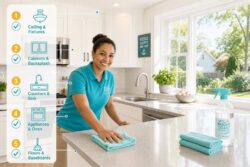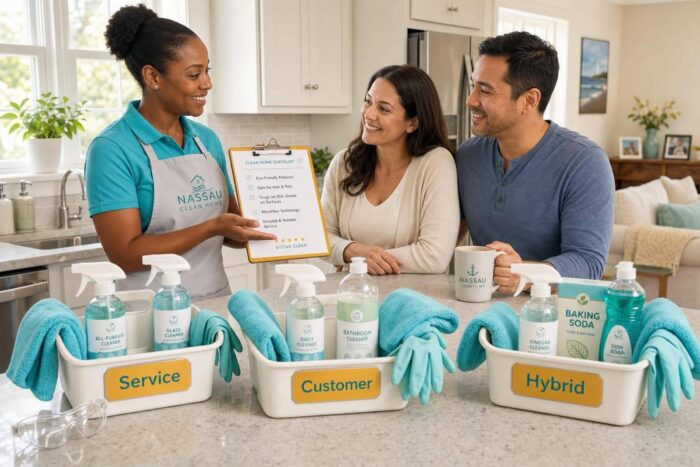
The short answer: in Nassau, the cleaner may bring supplies, you may need to provide them, or you may split the list. That choice affects price, prep, safety, and product control.
If I were booking a house cleaning today, I’d check these points first:
- Who brings supplies and tools
- Whether the price already includes them
- If I need special products for marble, stone, hardwood, pets, kids, or allergies
- What I still need to leave out, like trash bags, linens, or a labeled stone cleaner
- How to avoid product mistakes, such as mixing bleach with ammonia or vinegar
The article’s core points are simple:
- A service-supplied setup is the easiest for me if I want less work before the visit.
- A customer-supplied setup gives me the most control, but I need to stock and store everything.
- A hybrid setup works well when I only want control over a few items, like pH-neutral cleaners for stone.
- In Nassau, listed starting prices are $229 for standard cleaning, $329 for deep cleaning, and $379 for move-in/move-out cleaning when supplies are built into the rate.
- Even when a company brings products, I may still need to provide trash bags, linens, and any surface-specific cleaner I want used.
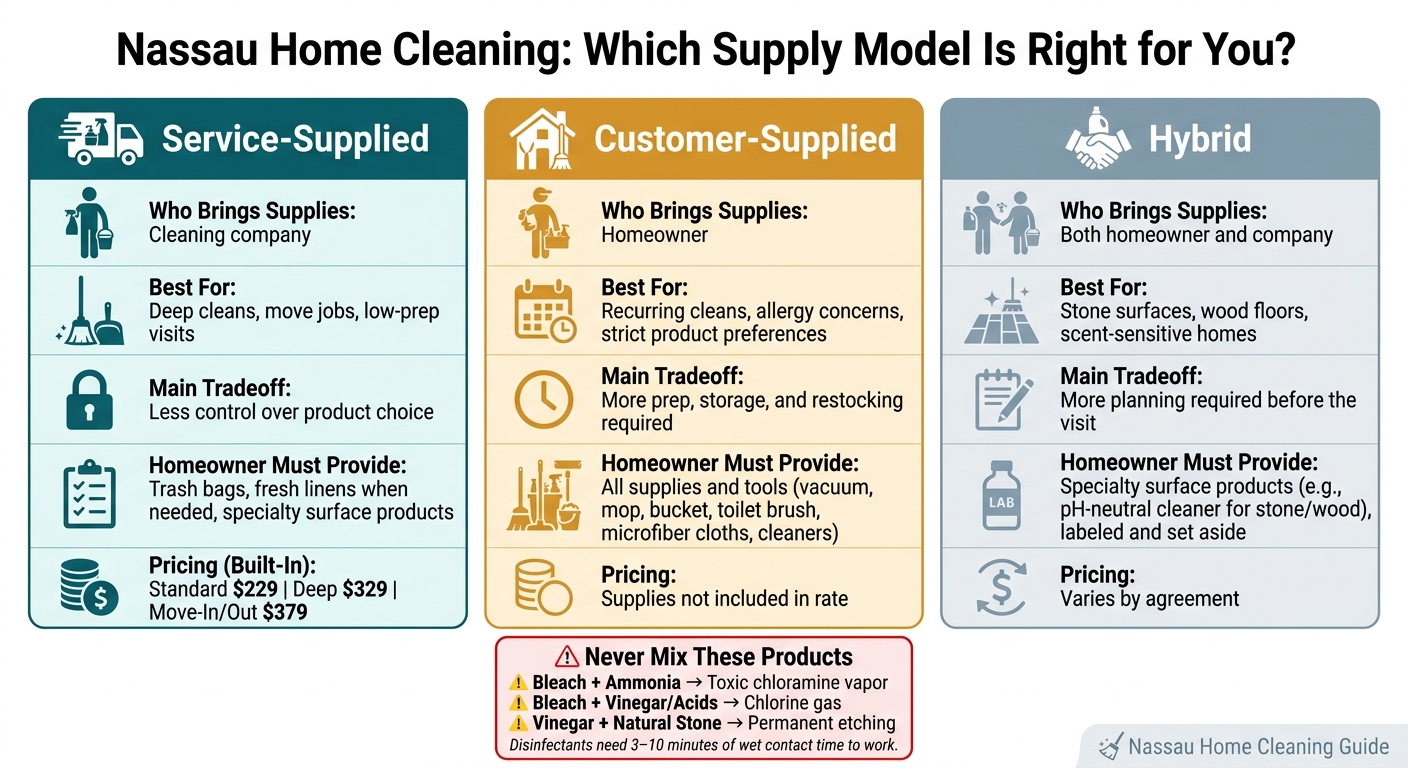
Nassau Home Cleaning Supply Models: Service vs. Customer vs. Hybrid
Who Provides the Cleaning Supplies – Me or the Maid?
sbb-itb-a8bcf38
Quick Comparison
| Model | Who brings supplies | Best for | Main tradeoff |
|---|---|---|---|
| Service-supplied | Cleaning company | Deep cleans, move jobs, low-prep visits | Less control over product choice |
| Customer-supplied | Homeowner | Recurring cleans, allergy concerns, strict product choice | More prep, storage, and restocking |
| Hybrid | Both | Stone surfaces, wood floors, scent-sensitive homes | More planning before the visit |
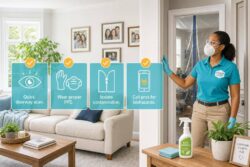
A few safety points matter most. Bleach should never be mixed with ammonia or acids, and stone surfaces should not be cleaned with vinegar. For disinfectants, the surface often needs to stay wet for 3 to 10 minutes to do the job.
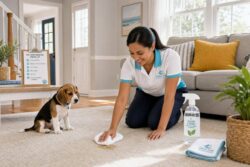
Before the cleaner arrives, I’d make sure floors and counters are clear, pets are secured, valuables are put away, and access details are shared ahead of time. That can help avoid delays and possible waiting fees of about $35 per hour.
If I had to sum up the full article in one line, it would be this: pick the supply model that matches how much control you want and how much prep you’re willing to do.
How to Choose the Right Supply Model for Your Home
Cost, Convenience, and Pricing Predictability
Once you know how each model works, the choice usually comes down to cost, control, and convenience.
The big tradeoff is simple: are supplies included in the rate or not? With a service-supplied model, the company brings the products and tools, and those are built into the flat rate. Standard cleaning starts at $229, deep cleaning starts at $329, and move-in/move-out service starts at $379 [1].
With a customer-supplied setup, you handle the supply side yourself. That means keeping on hand whatever the service expects, and some service types may call for a vacuum, toilet brush, bucket, and mop [2]. It can work well, but it also means you need space to store everything and a system to keep items restocked.
Product Control for Allergies, Pets, Kids, and Delicate Surfaces
A customer-supplied or hybrid model makes more sense when product control matters more than convenience.
For homes dealing with severe allergies, asthma, or fragrance sensitivity, many homeowners would rather use their own fragrance-free or low-VOC products [4]. At the same time, many cleaning services use eco-safe products that work well in homes with children and pets [1].
Surface type matters too. Natural stone, marble, granite, and unsealed hardwood can be damaged by the wrong cleaner [4]. If your Nassau home has high-end finishes, a pH-neutral cleaner is a safer pick for those surfaces [4]. It also helps to spell out product requests when you book the service – for example, one cleaner for the kitchen and another for stone or wood [2].
When a Service-Supplied Model Is the Better Fit
A service-supplied model is often the easier option if you don’t want to buy, store, or replace products and tools yourself.
Professional teams usually show up with eco-safe supplies made for different materials, which may help cut down on residue on finished surfaces [4].
Next, match your supply model to the exact supply list your home needs.
Cleaning Supply Lists for Nassau County Homes
Basic Supply Kit for Standard Home Cleaning
If you’re providing the cleaning products, have these tools ready: a vacuum, mop, bucket, and toilet brush [2]. For cleaners, stock an all-purpose cleaner, glass cleaner, disinfectant, toilet bowl cleaner, and a floor cleaner that fits your flooring type [6].
A couple of items often slip through the cracks: microfiber cloths and trash bags. Pros suggest keeping 6–8 microfiber cloths per session, and it helps to color-code them by area so you don’t spread mess from one space to another [6]. Trash bags matter too. Cleaners will often empty bins, but homeowners usually need to supply the replacement bags [3].
If you have stone or unsealed wood, use a pH-neutral cleaner [4].
Expanded Kit for Deep Cleaning and Move-In or Move-Out Service
For customer-supplied deep cleans or move-related jobs, you’ll need more than the basics. Add a heavy-duty degreaser for backsplashes, a soap-scum remover for shower buildup, a grout cleaner, and an oven cleaner [3][4]. Detail brushes for baseboards, vents, and door frames also help, along with stainless steel polish and wood polish [3].
Move-in cleans can come with their own mess. In newly renovated Nassau homes, fresh drywall dust may call for extra dusting cloths and stronger dust-removal products [3]. For move-out cleans, cabinets and drawers should be fully empty before the team arrives, since pros usually don’t clean inside storage spaces that still have items in them [3].
What Homeowners Still Need When the Cleaning Service Brings Supplies
Even when the service brings its own products and tools, homeowners still need to have a few things ready. Trash bags are often still needed, and fresh linens may be needed if the visit includes bed-making or laundry [3]. If you use a special cleaner for stone or wood, label it clearly and leave it set aside for those rooms [2][4].
The table below compares the three setups:
| Feature | Basic Home Kit | Deep Clean Kit | Service-Provided Setup |
|---|---|---|---|
| Core Chemicals | All-purpose cleaner, glass cleaner, disinfectant, toilet bowl cleaner, floor cleaner | Heavy-duty degreaser, soap-scum remover, grout cleaner, oven cleaner | Company-provided cleaners and tools |
| Specialty Items | pH-neutral cleaner for stone/wood | Stainless steel polish, wood polish | Company-provided cleaners and tools |
| Tools | Vacuum, mop, bucket, toilet brush, microfiber cloths | Detail brushes, scrub brushes, extra cloths | Tools provided by the team |
| Homeowner Must Provide | All supplies and tools | All supplies plus specialty chemicals | Trash bags, fresh linens when needed, specialty surface products |
If your home has more than one bathroom, it helps to keep a small kit under each sink with a toilet brush, disinfectant, and glass cleaner. That way, cleaners don’t have to carry wet supplies from one bathroom to another [6]. Once your kit is set, the next step is handling safe storage, booking notes, and access instructions.
Safety Rules, Booking Details, and Home Prep Before the Visit
Safe Product Use and Storage at Home
Once you know who’s bringing the supplies, the next step is using and storing those products safely at home. Start with safety first, then move to booking details and prep.
Store cleaning products where children and pets can’t get to them. If you use special products for stone, wood, or stainless steel, label them clearly so no one grabs the wrong bottle by mistake.
Avoid these product mixes and surface pairings:
| Product Combination | Risk | Why It’s a Problem |
|---|---|---|
| Bleach + Ammonia | Toxic chloramine vapor | Can cause severe respiratory damage or hospitalization [4] |
| Bleach + Acids (e.g., Vinegar) | Chlorine gas | Highly toxic; even vinegar reacts dangerously [4] |
| Vinegar + Natural Stone | Etching/dulling | Acid can permanently damage marble and limestone finishes [4] |
| Abrasives + Stainless Steel | Scratching | Can damage the grain and finish of appliances [4] |
| Excess product + Hardwood | Cloudiness/buildup | Can leave a sticky, dull film that attracts dirt [4] |
A small mix-up can turn into a big problem fast. Bleach and ammonia, for example, are a hard no.
Disinfectants also need time to work. In most cases, the surface needs to stay wet for 3 to 10 minutes before wiping [4].
What to Confirm When Booking Your Cleaning
After you pick a supply setup, pin down the service details before you book.
Ask who provides the supplies. Some companies bring all chemicals and tools, while others expect you to provide things like a vacuum, mop, bucket, and toilet brush [2]. If you want a certain product used on stone, hardwood, or stainless steel, put that request in writing. Also check whether interior oven cleaning, refrigerator cleaning, or laundry are part of the visit, since those are often separate flat-fee add-ons [2].
It also helps to confirm how pricing works. Ask whether the quote is based on fixed time or a flexible window, since flexible windows can cost less [2]. And if your requested product isn’t available, find out whether the team will use its standard substitute or if you should leave your preferred product out on the counter [2].
How to Prepare Your Home and Share Access Instructions
Once supplies and booking details are set, get the home ready so the cleaners can begin right away.
Clear floors and countertops so the team can reach the surfaces they need to clean. They may straighten soft items, but floors and counters should already be open. For move-in or move-out cleans, leave the home mostly empty so they can get to cabinets, corners, and baseboards [3][5].
Before the visit, secure medications, jewelry, and other valuables. If there’s anything you want the team to avoid, note it in your booking comments [2]. Keep pets secured too, since standard service does not include pet waste cleanup.
Access details matter more than people think. Share door codes, alarm steps, and parking notes in advance so you don’t run into waiting fees of about $35 per hour [2]. For a first cleaning, it’s often smart to be home for the walkthrough so you can show the team around and point out your priority areas [2].
If you’re supplying a vacuum or mop, leave it clean and in working order.
What to Expect on Cleaning Day and Key Takeaways
Service-Day Expectations for Standard, Deep, and Move-Related Cleans
After you’ve confirmed supplies, access, and prep, cleaning day usually comes down to scope and timing. Standard cleans are the shortest, deep cleans take more time, and move-in or move-out cleans are the most labor-heavy [3][5].
If your team brings its own supplies and tools, the visit usually starts faster because there’s no setup needed from you [1]. If you’re providing tools instead, set out only clean, working equipment before they arrive [2]. It also helps to use your booking notes or a quick walkthrough to point out odor sensitivities, residue concerns, and delicate surfaces like natural stone or unsealed wood [1][2][4].
Most cleaning teams won’t move heavy furniture or clean areas that require a ladder [2][3].
Key Points Nassau Homeowners Should Remember
For most Nassau homeowners, the big choice is pretty simple: Do you want more control over the products, or less prep before the visit? A service-supplied setup means less work for you and no need to keep track of supplies. A customer-supplied or hybrid setup gives you more control over ingredients and surface finishes [1][2][4].
A lot of headaches can be avoided just by being clear at booking. Confirm who’s bringing what, ask about add-ons like inside-oven or fridge cleaning, and share access details before the appointment [1][2].
FAQs
Which supply model fits my home best?
Choose based on how hands-on you want to be. If you don’t want to stock anything, go with a fully equipped team. They’ll bring pro-grade, eco-friendly supplies and tools, and you’ll only need to flag any special product requests.
If you plan to provide the products or handle some of the cleaning yourself, set out multi-surface or all-purpose cleaners ahead of time, plus any disinfectants for high-touch areas.
For move-in/move-out cleaning, pros should work from an inspection-ready checklist and clean inside cabinets and appliances too.
What should I leave out before the cleaner arrives?
Remove personal items from the areas being cleaned so the team can do a full, careful job. Pick up clutter and loose items first, because too much mess can keep the service from being finished.
For deep cleaning or move-in/move-out cleaning, empty cabinets, drawers, and medicine cabinets if you want the inside surfaces cleaned. Also make sure heavy appliances or furniture aren’t left in the space if you’re expecting that type of detailed cleaning.
How do I avoid using the wrong products on stone or wood?
Read product labels with care before you use anything. Harsh or acidic cleaners, like vinegar, can damage natural stone and leave wood finishes looking dull.
If you hire professionals, spell out your instructions when you book. And if you want certain products used, ask for those instead of the standard eco-friendly supplies.