
You do not need a new window every time you see fog. In many cases, the fix depends on one simple check: where the moisture is. If it wipes off, it’s usually a surface issue. If it stays stuck between the panes, the insulated glass seal has likely failed.
Here’s the short answer:
- Fog on the inside surface: Lower indoor humidity to 30%–50%, run exhaust fans, and seal drafts.
- Fog on the outside surface: This is often morning dew and may clear on its own.
- Fog between panes: Cleaning won’t fix it. A defogging service may clear the view for 1–3 years, but IGU glass-only replacement is the long-term repair and often costs about $150–$400+.
- Before paying: Check the warranty. Many windows have 10- to 20-year seal-failure coverage.
- Safety warning: Do not drill tempered glass, especially near doors or floor-level windows.
If I wanted the fastest way to sort this out, I’d do three things first:
- Wipe both sides of the glass
- Check for cracked caulk, worn weatherstripping, and clogged weep holes
- Confirm whether the fog is on the surface or trapped inside the unit
| Fog location | Likely cause | What I’d do |
|---|---|---|
| Inside surface | High indoor humidity or cold glass | Lower humidity, improve airflow, seal drafts |
| Outside surface | Dew on outer glass | Wait, clean, or use a rain-repellent treatment |
| Between panes | Failed double-pane seal | Check warranty, then defog or replace the IGU |
Bottom line: I’d match the fix to the fog location, not the look of the window.
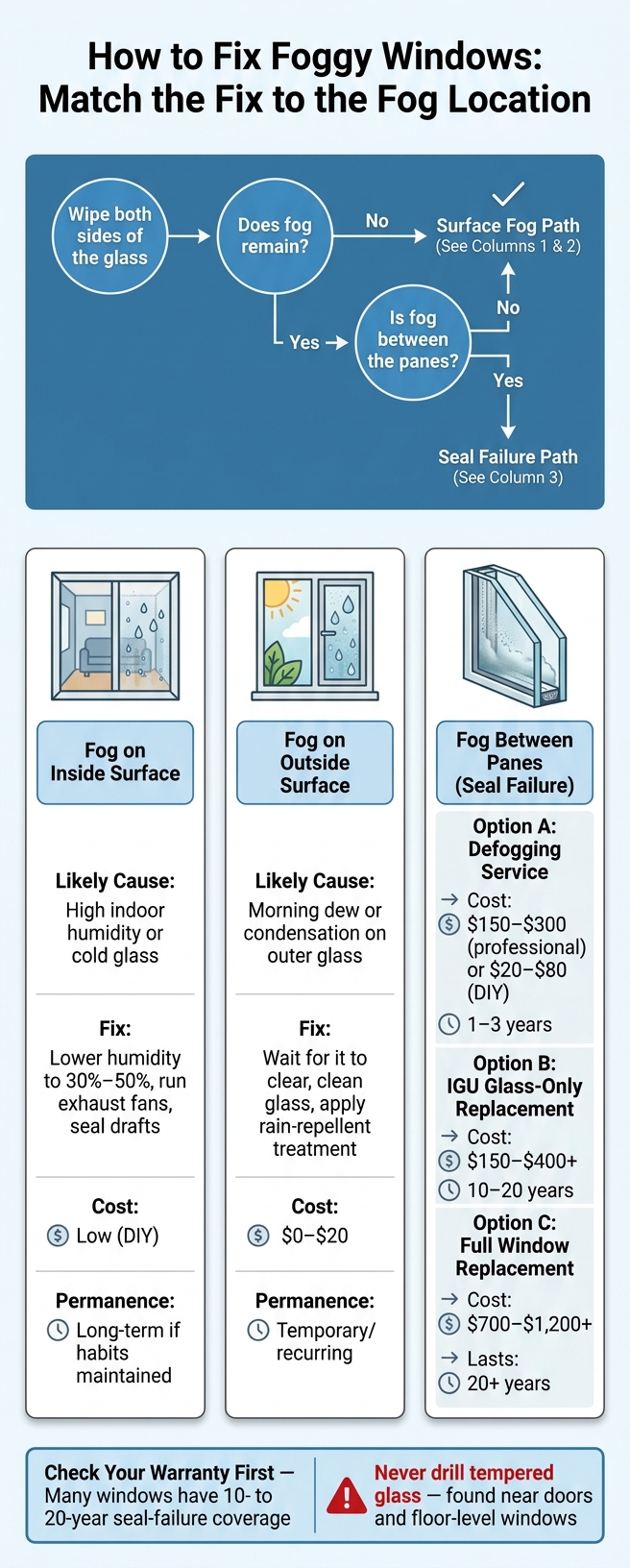
Foggy Window Fix Guide: Compare Costs, Causes & Solutions
Cleaning a Foggy/Hazy Window Insulated Glass Unit (IGU) from the Inside, Without Replacing the Glass
sbb-itb-a8bcf38
Inspect the window and decide which repair path to take
If the fog isn’t on the glass surface, inspect the frame next.
Check where the moisture is and what the frame looks like
If the fog is on the glass surface, the frame and drainage system are the next places to check.
Fog that stays put after you wipe both sides usually points to a failed IGU seal [1][6].
Once you know where the moisture is, take a close look at the frame and sash. Wet sills, peeling paint, or mold odors usually mean moisture has been hanging around for a while. Check the bottom of the frame for weep holes, the small drainage slots built into vinyl and wood-clad sashes. When those get packed with dirt or debris, water can sit against the seal and wear it down faster [2][4]. You can clear them with compressed air or a small wire.
Then check the caulk line around the frame and the weatherstripping along the sash edges. Cracked caulk or glazing tape that has pulled away can let cold air chill the glass surface. That can lead to condensation that looks like seal failure, even when the seal isn’t the issue [1][4].
| What You See | Likely Cause | Next Step |
|---|---|---|
| Fog stays after wiping both sides | Failed IGU seal | Replace the glass unit |
| Milky white streaks or mineral film | Long-term seal failure | Replace the glass unit |
| Clogged weep holes, wet sill | Poor drainage | Clear holes; check for rot |
| Cracked caulk or worn weatherstripping | Air leak at frame | Recaulk and reseal |
When to avoid drilling or DIY glass work
If the frame is in good shape and the fog is trapped between panes, move on to the glass-unit repair options.
If your inspection points to a failed seal, you may run into defogging kits that tell you to drill small holes into the glass. That can be risky, and the risk depends on the type of window.
Never drill into a door, sidelite, or any window installed near the floor. These are usually made from tempered safety glass. Do not drill tempered glass; it can shatter right away.
There’s also the warranty issue. Drilling voids most manufacturer warranties. Many high-quality windows come with a 20-year warranty for seal failure, and you can often find the serial number or manufacturer’s name etched into a corner of the glass or printed on the spacer bar. Check that first [2][3]. Coastal salt air and freeze-thaw cycles can wear seals out faster, so it’s smart to inspect nearby windows too [6][3].
If drilling isn’t safe or the unit is hard to reach, have the IGU measured by a glass specialist. For large or hard-to-reach units, use a glass specialist to measure the IGU.
Fix surface fog with cleaning, humidity control, and basic sealing
If the fog is on the surface of the glass, focus on three simple fixes: clean the glass, lower indoor humidity, and seal air leaks around the frame. Surface fog usually responds to those steps.
Clean the glass and apply short-term anti-fog treatments
Start with a thorough cleaning using a microfiber cloth and a mild, pH-neutral glass cleaner. Don’t spray the cleaner straight at the glass edges. If liquid seeps into the seal perimeter, it can wear that area down faster.
For exterior surface fog, use an anti-fog or rain-repellent glass treatment, like the kind used on windshields. The goal is simple: help water bead up and roll off instead of lingering on the surface. These products don’t last forever, so you’ll need to apply them again from time to time.
If the haze is still there after you wipe both sides, the issue may not be surface fog at all. At that point, move to the glass-unit repair options.
Lower indoor humidity to between 30% and 50%
Keep indoor relative humidity between 30% and 50% [2][1][7]. That range helps cut down on condensation without making the air feel too dry.
A few easy ways to bring moisture levels down:
- Run your bathroom exhaust fan during showers and for 10 to 20 minutes after [1]
- Use your kitchen exhaust fan while cooking
- Vent your clothes dryer directly outside
- Move houseplants away from windows during colder months
- Run a dehumidifier in a damp basement to lower the home’s moisture load
- Open blinds or shades slightly in winter so air can move across the glass and reduce condensation [1][7]
If condensation keeps coming back even after humidity drops, the next place to look is the frame seal.
Reseal drafts around the frame, not between the panes
Caulk and weatherstripping help stop cold air from leaking through the frame and chilling the glass surface. Check the caulk line where the window frame meets the exterior wall. If it’s cracked or pulling away, apply new exterior caulk.
You should also seal gaps where the glass meets the frame. That can cut drafts and slow water from getting in around the perimeter. But here’s the catch: resealing the frame does not fix the airtight seal inside a double-pane unit, and it won’t clear fog that’s already trapped between the panes.
Use defogging kits or replace only the glass unit inside the frame
If the frame is still in good shape but the fog sits between the panes, your options get narrow fast. At that point, you’re usually choosing between a short-term defogging kit and a permanent IGU replacement.
Drill-and-vent defogging kits: lower cost, limited results
With this method, a technician, or a careful DIYer, drills small holes into the glass unit, flushes out the moisture, dries the cavity, and adds vents or plugs. It can clear the fog, sure. But here’s the catch: it does not bring back the original airtight seal.
That matters because defogging changes a sealed double-pane unit into a less efficient setup. So while the glass may look better, the window itself won’t perform the way it did before.
Professional defogging usually lasts 1 to 3 years [2].
- DIY defogging: $20–$80; short-term results; high risk of breakage or a voided warranty [2]
- Professional defogging: $150–$300; lasts 1 to 3 years; low impact on energy efficiency [2]
If you want a fix that holds up, IGU replacement is the next step.
Glass-only replacement: the permanent fix for failed double-pane seals
Replacing just the insulated glass unit, while keeping the current frame, is often the most cost-effective way to fix a failed double-pane seal and bring back both clarity and energy efficiency [2]. A glazier removes the old IGU and installs a new factory-sealed unit in the same frame, which helps keep labor and cost far below a full window replacement.
A properly installed IGU can last 10 to 20 years [5]. That’s a big jump from the 1-to-3-year life span you usually get from defogging.
- IGU replacement: $150–$400+; lasts 10–20 years; frame stays in place [2][5]
- Full window replacement: $700–$1,200+; lasts 20+ years; high labor complexity [2][3]
Before paying for either repair, check whether the unit still has seal-failure coverage.
Conclusion: Match the fix to the problem before spending money
Inspect the window first, then match the repair to the source of the fog. The first thing to check is where the fog sits: on the surface or between the panes. That one detail points you toward the right fix, whether that’s cleaning, sealing, defogging, or IGU replacement.
If the fog is on the surface, the issue usually comes back to indoor humidity or gaps around the frame. In that case, humidity control and frame sealing are the right next steps. If the fog is between the panes, you’re looking at defogging or a full IGU replacement.
Key points to remember before paying for repairs
Check the warranty first. Many windows come with a 10- to 20-year seal-failure warranty, and you can often find the manufacturer’s name etched into a corner of the glass or stamped on the spacer bar [3][2].
If the warranty has expired, IGU replacement usually costs $150–$400+. It can last 10 to 20 years and restores energy efficiency, which makes it a stronger long-term choice than defogging, since defogging is only a temporary fix [2][5].
And one more thing: do not drill tempered glass.
Choose the fix based on fog location, not just how the window looks.
FAQs
How can I tell if my window seal is broken?
Try a simple wipe test. If you can wipe away the moisture on the inside or outside of the glass, it’s probably surface condensation caused by humidity or temperature shifts.
If the fog, haze, or white mineral streaks are stuck between the panes and won’t wipe off, the insulated glass unit (IGU) seal has likely failed. Distorted reflections can point to the same issue.
Is defogging worth it, or should I replace the IGU?
Defogging is usually a short-term cosmetic fix, not a full repair. It can clear the visible haze by letting moisture escape, but it doesn’t restore the original seal or the insulating gas inside the window. That means the window remains less efficient, and the fog can come back later.
Replacing the IGU is the better long-term option when the frames are still in good shape. It brings back clear glass and better energy performance without the cost of replacing the entire window.
Can foggy windows cause mold or higher energy bills?
Yes. When a window seal fails, the gas between the panes can leak out. That means the window loses some of its insulating power, so your heating and cooling system may have to work harder. Over time, that can push energy bills up.
Moisture trapped around the window frame can also lead to water damage and create the kind of damp conditions mold likes. Defogging may get rid of the cloudy look, but it doesn’t bring back the original seal or the window’s insulation.